1、Design evaluation
The first step in customization is bottle design, but this is not only about polishing the appearance, but also a technical evaluation of the feasibility of the mold. Many brands directly look for factories with renderings, but ignore that packaging must first serve the formula. You need to first determine the product type: essence dropper bottle, face cream jar, toner spray bottle or oil split bottle, and determine the capacity, acid-base property and photosensitivity of the formula. Excellent design must consider the demolding angle to ensure that the bottle body has sufficient slope for smooth demolding; At the same time, it is necessary to ensure uniform wall thickness to avoid deformation or breakage of the glass due to stress concentration during cooling shrinkage. In addition, the position of the parting line needs to be cleverly hidden (such as at the edges), and surface treatment (smooth, frosted, or textured) also needs to be planned in advance, as this directly determines the processing method of the subsequent mold cavity.
2、Mold development and material commissioning
The next step is the mold making and sampling process, which is also the most expensive and variable step in customized projects. New private molds are usually produced first as sample molds, which are used to make prototype and pre production samples, rather than directly going to mass production molds. A mold is a direct carrier for shaping glass, usually made of heat-resistant alloy steel through precision machining. The smoothness inside the mold cavity is directly replicated on the surface of the glass bottle. If it is an irregular bottle or a bottle body with three-dimensional texture, the structural design of the mold needs to be repeatedly deduced to ensure that the molten glass liquid above 1500 ℃ can fill every detail, and after cooling and shrinking, it can be smoothly demolded without problems such as mold jamming or missing details.
The regular sample mold cycle is about 15-25 days. After receiving the sample, you cannot only look at its appearance. You must conduct a complete set of tests: capacity verification, torque testing, high and low temperature cycling testing, leakage testing, drop testing, and most importantly, formula compatibility testing - pour your real material into the sample and store it in the dark to observe whether it changes color, precipitates, or corrodes the inner wall. Many brands only check the appearance and only discover that the formula and coating have reacted when the bulk is filled, resulting in the entire batch being scrapped. If the sample does not pass in one round, adjust the structure, color, or process. Repeat multiple iterations until the sample is sealed. The sealed sample will serve as the sole criterion for subsequent bulk acceptance.
3、Craftsmanship avoids pitfalls: details determine a sense of sophistication
Surface treatment and printing technology are powerful tools to increase product premiums, but they also have hidden traps. Although electroplating technology can bring a luxurious metallic feel, it is prone to leaving fingerprints and should not be paired with shrink film to avoid sticking; The hot stamping process is full of luxury, but if the font size is less than 3mm, it is easy to paste and should avoid the large curvature area of the bottle body. The most crucial testing step cannot be omitted: after receiving the sample, it is necessary to conduct a "violent test" - testing for deformation with hot water, testing for leakage after 24 hours of inversion, and repeatedly wiping the logo with an alcohol swab to test adhesion. Remember that there may be color differences between the sample and the bulk order, and the contract should specify a clause stating that "if the color difference exceeds Pantone color card ± 10%, the factory shall bear the responsibility".
4、Sample validation and batch acceptance, last mile of closed-loop
Before the formal mass production, the factory will first produce a small batch of sample bottles, and the brand must complete three core verifications: first, filling and fitting tests to confirm that the bottle mouth matches the selected pump head and inner plug perfectly, and there will be no leakage or pump jamming problems; Next is the compatibility test of the contents, which involves pouring the actual skincare product into a bottle and observing it to confirm that the glass material and surface coating will not react with the contents; Finally, there is a transportation simulation test to confirm that the impact resistance strength of the bottle body meets the logistics distribution requirements.
Only after confirming that all sample details are correct can mass production be initiated. Before the final product leaves the factory, it is necessary to complete the full project testing of dimensional accuracy, wall thickness uniformity, internal pressure resistance, sealing, etc. one by one to ensure that each batch of bottles is completely consistent in performance and appearance with the originally confirmed sealed sample.
5、Experience closed-loop: precise bite between bottle mouth and lid
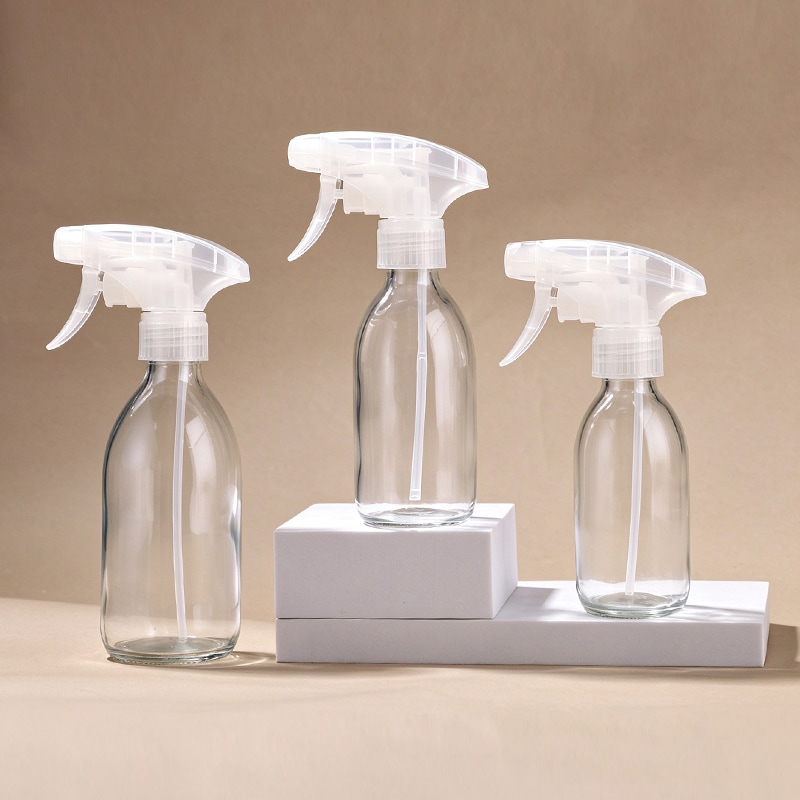
The bottle mouth standard (such as 18 teeth, 20 teeth) must be strictly matched with the lid, and fine teeth and coarse teeth cannot be mixed. For essence or lotion, the liquid output, rebound feel and sealing of the dropper or pump head are crucial. An excellent dropper system should achieve no dripping or wall hanging, and the silicone rubber head should have oil resistance. Only when the glass bottle body and accessories function perfectly can a closed-loop experience from visual attraction to pleasant use be truly achieved.